


Did a friend forward this to you? Get the latest insights in your inbox monthly by subscribing here!
Subscribe Here | Twitter | Bluesky | Website | Research | Contact | Donate
I previously wrote about the trillions of dollars in capital expenditures by Meta, Alphabet (Google), Microsoft, Amazon, and Oracle. Most of it earmarked for data centers hosting AI services. Combine this with both OpenAI and Anthropic racing toward trillion-dollar valuations, and we are in an AI bubble. The vital question is who bears the costs when the market self-corrects, and which companies will come out on top. Unlike OpenAI and Anthropic, Alphabet, Meta, Microsoft, and Amazon generate billions in revenues from digital advertising, enterprise services, cloud, and e-commerce, making them more likely to survive and maintain their market dominance.
The lack of timely and effective antitrust enforcement allows companies like Google to stay on top as AI infiltrates everything, including search: even if you hate AI, you will use Google AI search. That is why timing matters in the Google search case. Every month of delay in implementing the remedies helps Google further leverage its search monopoly into AI via its unique ability to distribute search by remaining the default service on smartphones, in Safari and in Chrome. Its unparalleled web search index, built on its search monopoly over decades, also allows it to better train and ground its AI software.
Yes, Google’s efforts to delay implementing court-ordered remedies make business sense for Google. And yes, the company has the right to appeal. But Google’s efforts to starve The Technical Oversight Committee of its resources, while loudly claiming it’s not engaged in delay tactics, is cynical to say the least.
The longer we’re forced to wait, the more we lose independent news sources and publishers as yet another casualty of Google’s dominance in search. As Google’s AI powered search uses publishers’ content to answer user queries without the users clicking through, traffic and revenue that typically sustain journalism and the open web erode. The UK CMA has taken a positive first step by requiring Google to give publishers granular opt-outs from AI Overviews, AI Mode and model training, as well as provide engagement metrics, clear attribution, and no retaliatory downranking. Google plans to roll out these changes globally. But it is still early days. The rollout will take at least a year, and US implementation will be left to Google with no oversight.
More generally, the lack of effective coordination among different authorities when it comes to addressing Big Tech’s market power is a major problem and one that companies can exploit to undermine any guardrails or regulation. For example, it has not escaped my attention that soon after Peter Thiel moved to Argentina, President Milei released plans to make Argentina a regulation-free zone for AI. He proposes granting AI personhood and allowing it to operate freely under a limited-liability “nonhuman corporation” model. As the historian Yuval Noah Harari says:
It will be extremely dangerous at this point for any country to recognize A.I.s as persons — to allow A.I.s, for instance, to open a bank account or manage a company by themselves….The moment you recognize A.I.s as legal persons, this is the moment you really lose control. Because then they can start doing a lot of things in the economic and social and political arena without any human accountability. For instance, donating money to politicians in exchange for the politicians taking care of giving more rights to A.I. persons.
While I am not sure how this idiocy in Argentina will end, NextGen will continue fighting for democratic control of markets and technology.
Thank you for reading and your support.
With regards,
Sumit Sharma
Executive Director
NextGen Competition
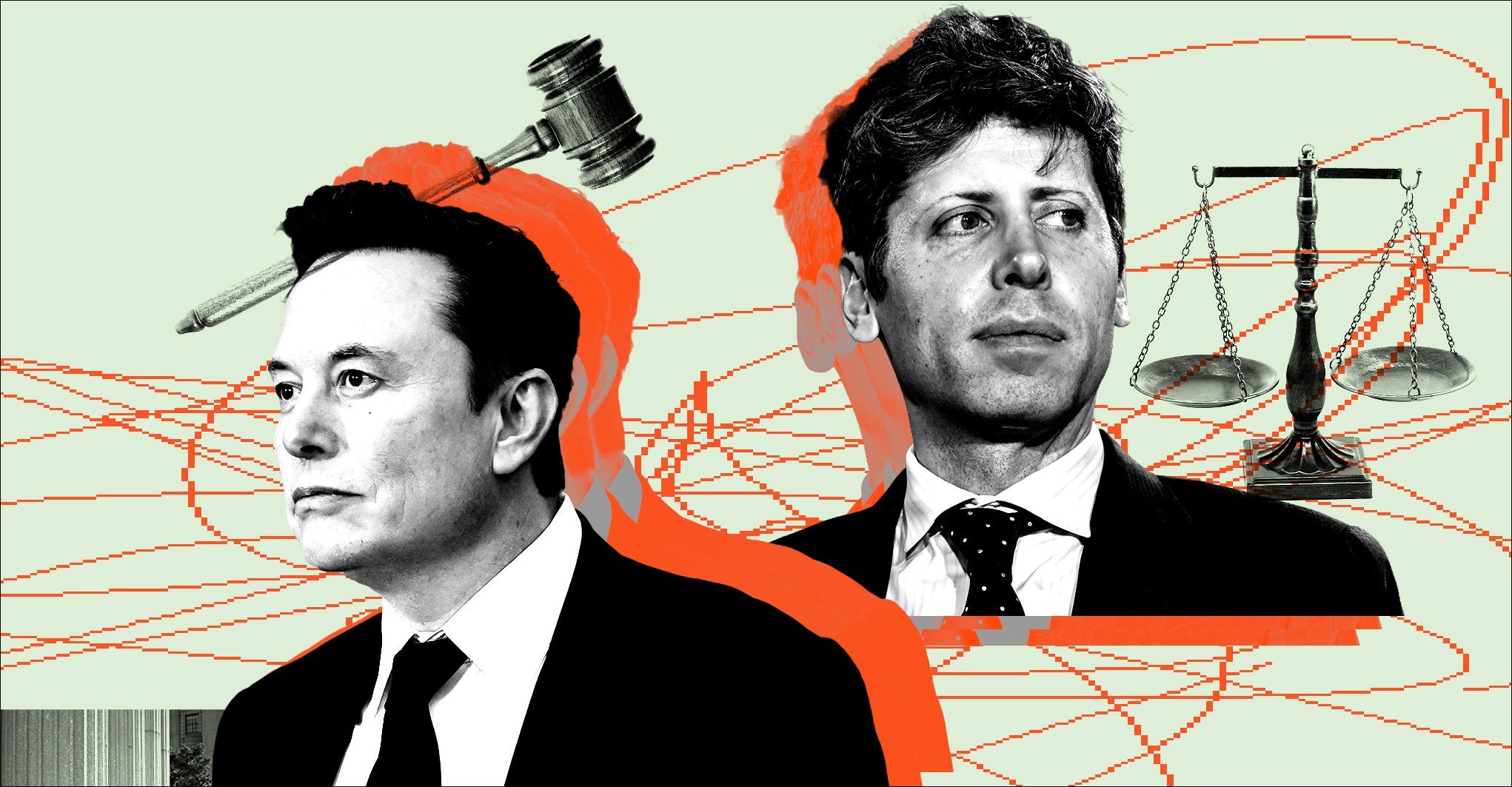
Musk v. Altman: The Collapse of One of Tech’s Biggest Bromances
In a battle waged over two years, the Musk-OpenAI trial may have concluded, but last month’s courtroom drama opened a revealing window into the personalities behind two of tech’s biggest names, the dispute over whether OpenAI betrayed its nonprofit mission, and what role Microsoft may have played in that mission creep.
Musk lost the case, but the trial illuminated what happens when inflated, volatile, human personalities clash over the development of non-human artificial intelligence capabilities. As cited in The Wall Street Journal:
“The proceedings revealed the mythmaking of AI’s seismic economic transformation, with heady talk of benefiting humanity and existential risk. It also exposed the AI boom’s underbelly: the grubby sidedeals, financial anxieties, short tempers and personal vendettas that have shaped modern technology every bit as much as the march toward machine consciousness.”
The conflict turned ugly, as both Musk and Altman attacked each other’s characters, egos, and intentions. Altman referred to Musk as existing “Probably his whole life from a position of insecurity — I feel for the guy.” While Musk referred to Altman as “Scam Altman,” a “liar,” and a “swindler.”
Credit: The Verge
The trial included testimony from Microsoft’s Satya Nadella, OpenAI President Greg Brockman, and Musk confidant Shivon Zilis, who served on OpenAI’s Board and is the mother of four of Musk’s children.
Did Sam Altman, with assistance from Microsoft, steal a charity, as Musk argued? We may never know, as the claims were dismissed because Musk waited too long to file suit. Musk is planning to appeal.
We particularly enjoy this summary of his counsel’s closing statement from NPR:
But, he said, since OpenAI launched a for-profit subsidiary in 2019 — after Musk departed — Altman and his fellow executives have treated the nonprofit as a “shell,” transferring intellectual property and the vast majority of employees to the for-profit arm of the company. In 2023, Molo continued, after OpenAI made a $10 billion deal with Microsoft, the company failed to prioritize safety, abandoned its commitment to open sourcing and “enriched investors and insiders.” “They’re motivated by money: Microsoft and Altman,” Molo said.
So much for the public good, I guess.
How to Solve a Problem Like Data Centers
We’ve long warned about the flashpoint that data centers have become across the country, with law enforcement agencies now warning of “anti-tech extremism.” One solution put forth? Taxing AI. Last month, Sen. Elizabeth Warren penned an op-ed for TIME on just that, writing:
AI holds tremendous promise. At the same time, Americans are rightly concerned that AI could further rig our economy. The technology is creating dozens of tech billionaires, while companies are laying off workers in the name of AI. Meanwhile, AI data centers are jacking up utility bills; for families living near large data centers, electricity costs have skyrocketed by as much as 267% over the past five years. It’s no surprise that Americans are showing up at town meetings to protest data centers and communities across the country are fighting for data center moratoriums.
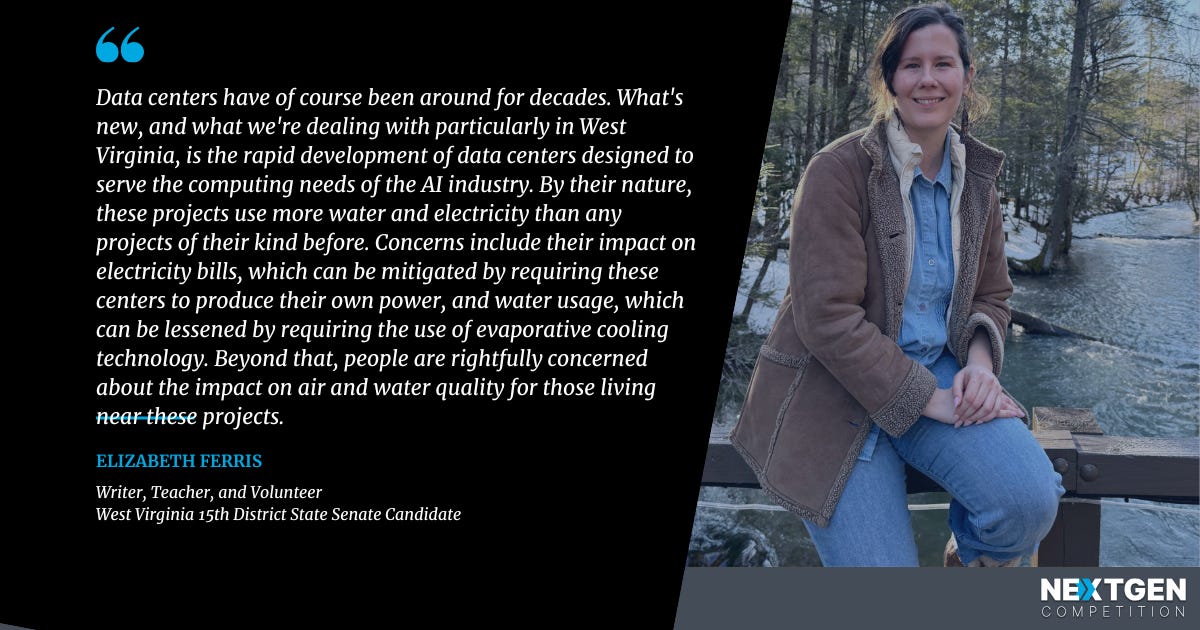
We’ve seen the effects of data centers on communities firsthand. In our latest Q&A, West Virginia State Senate candidate Elizabeth Ferris highlighted what risks the proliferation of these specific type of data centers pose:
And she is not the only candidate NextGen has featured who is raising concerns about the influx of data centers. Carleigh Beriont, running for Congress in New Hampshire’s 1st District, recently authored an op-ed warning about what Big Tech’s unchecked data center development could mean for communities in her state.
Whether Congress acts or states and cities continue stepping in with moratoriums and regulations, one thing is clear: communities expect and deserve transparency. Residents should know what data centers will mean for their utility bills, water supply, environment, and quality of life, and Big Tech companies should be required to show how they, not consumers, will pay for the costs they generate. 💸
Other Competition News
Headlines from the past month you might have missed:
Open(AI) and Shut Case: The Musk-OpenAI trial may not have been an antitrust case on paper, but Prasad Krishnamurthy argues it previewed potential upcoming competition fights that will shape AI’s future. The core question is whether firms like OpenAI and Anthropic can become independent competitors, or whether they will remain financially and operationally dependent on Big Tech:
This is the paradox of AI competition. There are thousands of AI firms, and the emergence of innovative leaders such as OpenAI and Anthropic suggests a dynamic market. Yet these leaders depend on the incumbents they might otherwise displace. The same tech giants that stand to benefit from AI’s growth have the incentive and capacity to ensure it doesn’t disrupt their existing businesses.
From cloud dependencies and equity stakes to quasi-acquihires and governance influence, antitrust enforcers have plenty to scrutinize if they want AI to be shaped by competition rather than steered by today’s tech giants.
Erin Brockovitch is Back: And she’s coming for data centers, launching a map to track where they’re popping up all over the country, including stats on where they’ve been proposed and where communities are concerned 🏭
The RACE to build AI infrastructures is unfolding town by town across America. In some places, data centers are welcomed. In others, they are delayed, contested or abandoned altogether. This MAP captures the real-world footprint of that race — revealing patterns of growth, conflict and uncertainty.
States of Enforcement: In POLITICO Magazine, Joseph Schatz argues that as the Trump administration eases off aggressive antitrust enforcement, state attorneys general are stepping into the breach. The story highlights the bipartisan group of 34 state AGs that rejected the DOJ’s Live Nation settlement, took the case to trial, and persuaded a jury that the company acted as a monopoly. If Washington won’t hold concentrated corporate power accountable, state enforcers increasingly will. 💪🏼
Brazil Leads the Way: As a major front in the global fight to rein in Big Tech, Brazil and its competition authority, CADE, are taking on Google in an investigation into whether the tech giant’s AI Overviews unfairly exploit news content and harm the Brazilian press. Big Tech isn’t making it easy, as Natalia Viana reports in .coda:
In the words of Arthur Lira, the Speaker in Brazil’s Congress who filed a criminal complaint against Big Tech executives in 2023, companies adopted a variety of tactics “to shut down democratic debate and intimidate lawmakers” and defeat any attempt at using legislation to force accountability. Google, he said, used its search homepage, used by over 85% of Brazilians, to spread fear that proposed laws would “make the internet worse” or “make it harder to know what is true or false on the internet.”
Against all odds, including U.S. pressure to weaken digital regulation, Brazil legislators aren’t deterred, and the fervor among the public to hold these platforms accountable is growing.
India’s Tech Tightrope: Two recent stories show India emerging as another major front in the global fight over Big Tech’s power.
Reuters reports that Apple is battling India’s competition authority over an antitrust case tied to the iPhone apps market, after investigators found the company abused its dominant position and sought financial information needed to calculate potential penalties.
Meanwhile, The Wall Street Journal details how Google’s $15 billion AI data center project in Visakhapatnam is raising alarms over water access, land displacement, public subsidies, and whether local communities are being asked to bear the costs of Big Tech’s infrastructure boom.
Together, the stories capture the central tension facing countries courted by Silicon Valley: how to benefit from tech investment without letting Big Tech turn local communities into collateral damage. 😵💫
Apple’s App Store “Hail Mary”: Apple is asking the U.S. Supreme Court to review a contempt order in its long-running fight with Epic Games, after courts found the company violated an injunction meant to open the door to outside payment options in iOS apps. According to Reuters, the dispute centers on Apple’s attempt to impose a 27% commission on some purchases made outside the App Store, a move Epic argues was designed to preserve Apple’s control while technically pretending to comply, stating the effort was:
“one last Hail Mary to delay a conclusion to this case and avoid opening up the gates to payment competition for the benefit of consumers.”
Golden is a Stretch: You’d think with all that time spent with Big Tech, the President would have been able to craft a phone that worked better and didn’t resemble the color of a “urine sample.” 😂
Until next month! In the meantime, follow us on X, BlueSky, and subscribe to our Substack for the latest on Big Tech, AI, and antitrust.