


Welcome to NextGen Competition’s monthly recap, delivering insider insights on antitrust battles, industry shakeups, AI trends, and more.
Did a friend forward this to you? Get the latest insights in your inbox monthly by subscribing here!
Subscribe Here | Twitter | Bluesky | Website | Research | Contact | Donate
Meta, Alphabet, Microsoft, Amazon, and Oracle are forecast to deploy $4 trillion in capital expenditures over the next five years! Most of this is earmarked for data centers that host AI services. These investments are risky and speculative like the infrastructure investment booms of previous years. Anthropic’s CEO, Dario Amodei, has warned that if AI growth forecasts are off by even a year, companies face bankruptcy.
Still ordinarily we celebrate private infrastructure investment – it is the engine of US economic growth. However, AI investment is different given its scale, yes, but also because it is competing for relatively scarce electricity and water resources.
The combined energy demand for these data centers will be the equivalent of adding a country the size of Spain to the American grid in just three years, and communities are bearing the costs of these developments. Residential electricity prices jumped 7.1 percent in 2025, more than double the rate of inflation, with increases topping 20 percent in some states. And yet communities bearing the brunt of this transformation have had almost no say in whether, where, or how these facilities are built. The secrecy surrounding these projects is remarkable. In Virginia, 25 of 31 communities with existing or proposed data centers had signed nondisclosure agreements with local officials, effectively shutting residents out of decisions that would reshape their neighborhoods. (See Consumer Reports – AI Data Centers: Big Tech’s Impact on Electric Bills, Water, and More)
It is also unclear what benefits if any these data centers provide to local communities. Research shows that despite billions in state tax incentives—Virginia and Texas each provide roughly $1 billion per year in data center tax exemptions—there is no clear evidence that data centers stimulate local growth in technology employment.
Think about that. Local politicians are subsidizing data centers and signing NDAs for projects that often raise electricity prices and create little local benefit. What does that say about the power of these tech companies?
Thankfully, there is growing awareness and backlash against the unchecked proliferation of AI data centers. Leaders like Bernie Sanders and AOC have taken note. We are also seeing candidates like Elizabeth Ferris, running for the West Virginia State Senate, who understand this issue. In a state being courted by billions in data center investment, she represents a new generation of policymakers willing to ask hard questions about who benefits and who pays.
The data center gold rush does not have to be a story of extraction and abandonment. As Daron Acemoglu and Simon Johnson argue in their book Power and Progress, (illustrated in this comic), the broad-based prosperity we enjoy today was not an automatic consequence of technological advancement— it was the result of citizens and workers organizing, challenging elite-dominated choices, and forcing ways of sharing the gains more equitably. From the industrial revolution to electrification, every transformative technology has required democratic engagement to ensure it serves the many rather than the few. We need an engaged public demanding accountability from both the companies reshaping their communities and the officials elected to protect them.
Thank you for reading and your support.
With regards,
Sumit Sharma
Executive Director
NextGen Competition
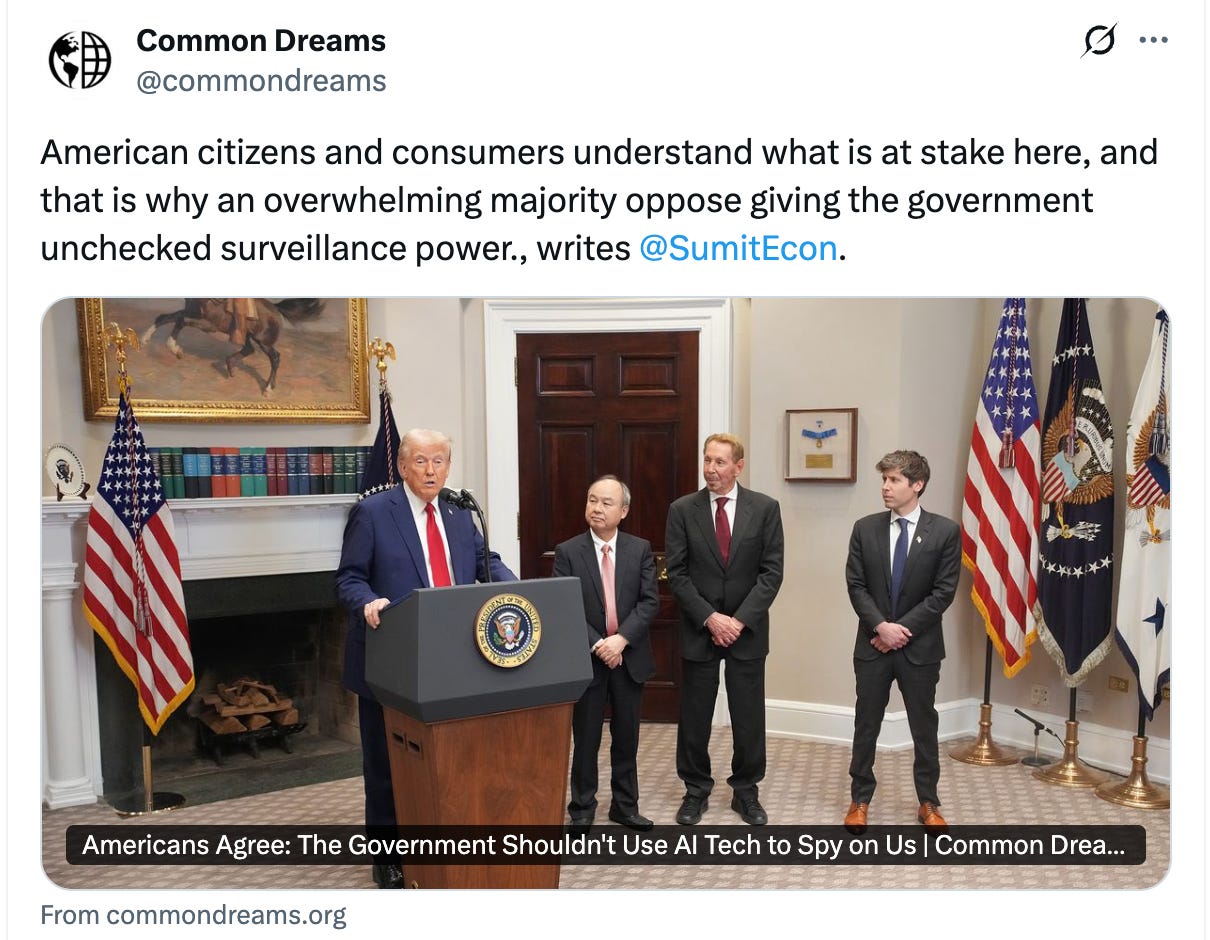
Americans Agree: The Government Shouldn’t Use AI Tech to Spy on Us
Three out of four Americans oppose giving the government unrestricted access to AI technology to surveil citizens, but Congress is asleep behind the wheel. In a new op-ed in Common Dreams, NextGen Competition Executive Director Sumit Sharma breaks down how OpenAI, Microsoft, and Amazon are enabling a domestic surveillance apparatus while hiding behind terms of service. Read it here.
Settling with an Illegal Monopoly: Welcome to the Era of Trump Antitrust
The strategy to avoid antitrust scrutiny by the Trump DOJ is now crystal clear. Hire the right lobbyists, pay off the President, and voila, you can sidestep an antitrust trial. Live Nation just proved it.
This month, the Department of Justice (DOJ) and Live Nation announced a settlement in the government’s landmark antitrust case. The same company whose employees called fans “stupid” and bragged about “robbing them blind” is now out of hot water. Instead of a breakup of Live Nation and Ticketmaster, the parent company will cap fees at 15% and pay $200 million in damages. The acting antitrust chief, Omeed Assefi, called it a deal to be “proud of.” The judge called the outcome “mindboggling,” and many Ticketmaster users agree.
Here’s how it happened. Live Nation was reportedly in talks with DOJ officials outside the antitrust division (going around the career enforcement staff) to cut a deal. Gail Slater tried to shut that down, objecting to a settlement and pushing for trial. Slater abruptly left her position on February 12. Less than a month later, the settlement was done.
A bipartisan group of state attorneys general is already pledging to continue the case to protect consumers because they were not part of the settlement discussions. Sen. Klobuchar and six Democratic colleagues sent a letter to AG Pam Bondi demanding DOJ records related to Slater’s ouster and communications between department leadership and Live Nation lobbyists. Sen. Warren put it plainly: “Under Donald Trump, antitrust enforcement has become a growing cesspool of corruption.”
In our recent interview with congressional candidate Carleigh Beriont, she said it directly: “When the administration uses antitrust enforcement as a political weapon or a prize, that’s corruption.” Live Nation’s settlement is Exhibit A.
Antitrust enforcers didn’t fail because they lacked the legal authority. They failed because the people at the top were working a different agenda. Many of the DOJ career staff did their jobs. The state AGs are doing theirs. It was the political appointees who folded after answering the right lobbyist’s call.
Other Competition News
Headlines from the past month you might have missed:
Google Settles with Epic: After a jury found Google’s Play Store an illegal monopoly and the Supreme Court was one rejection away from complete victory for Epic, both companies agreed to settle. According to Android Authority, the settlement reduces Play Store fees, allows third-party in-app and web payments, and streamlines competing store installs.
That sounds like a victory. But Judge James Donato isn’t so sure:
“The only changed circumstance that I can see right now is Epic and Google — two mortal enemies who pounded each other relentlessly in this courtroom for many years — are suddenly BFFs…right now I’m not saying it’s a bag of nothing, but it’s a bag of not great.”
He has since requested “friend of the court“ briefs before making a final decision, and the settlement remains unapproved.
Slater Gets the Last Word: After her abrupt departure last month, former AAG for Antitrust Gail Slater used The Regulatory Review to present her tenure at DOJ as a steady, principled effort to preserve competition amid political and bureaucratic turbulence. She highlighted several of the year’s major antitrust matters, including the Google search remedies trial, the RealPage settlement, and conditions on the Constellation-Calpine merger, while defending a pragmatic enforcement philosophy focused on “pocketbook markets” and institutional capacity. Whether that record ultimately matches the rhetoric is, of course, open to debate, but Slater leaves little doubt about how she wants her time to be remembered. ⚖️
A standout line:
“What I am most proud of during my tenure is that I never compromised on principles. I made decisions based on what I thought was best for American competition and consumers. The inevitable noise was not my concern—remember, a public servant is a temporary fixture and a steward for others. The noise is now quiet, while the signal persists.”
And on Live-Nation Ticketmaster (Would she have settled? 🤔):
“The Antitrust Division has twice tried to fix competition issues in the live entertainment market, but both consent decrees failed. Again, some cases just need to go to trial. We shall see if the third time will be the charm for the remaining states who chose to proceed to trial in the wake of the DOJ’s recent settlement announcement.”
DOJ in Shambles: If Slater’s piece offered a polished account of her time at DOJ, The Wall Street Journal supplies the darker version, detailing the chaos, pressure, and threats that reportedly led to her departure in February amid the HPE-Juniper controversy. According to the paper, Mike Davis, a lawyer for HPE and close Trump ally, allegedly told Slater, “If you don’t approve this settlement, I will destroy you. I will destroy your job at the DOJ.” 😳
Fixing Search Remedies: In a new paper, Executive Director Sumit Sharma lays out how to effectively implement and strengthen the remedies ordered in the Google search case, focusing on syndication, web search indexing, and user-side data sharing. He argues that while the current remedies provide key inputs for competition, their success will depend on flexibility, which would allow competitors to mix, match, and build on these tools over time. Sumit also highlights the need for ongoing industry engagement and potential adjustments to ensure the remedies can support a diverse group of competitors, not just replicate Google’s vertically integrated model.
Big Tech Commits to…Nothing: Earlier this month, Big Tech signed a “nonbinding” pledge that the current administration has touted with a White House event as a win to ensure taxpayers aren’t on the hook for the massive amount of electricity tech giants’ data centers will need.
Ari Peskoe, Director of the Electricity Law Initiative at the Harvard Law School Environmental and Energy Law Program, summed the event up nicely:
“This is theater. This is a press release designed to make it seem like they are addressing this issue. But this issue can only really be addressed by utility regulators or Congress. The White House doesn’t really have a lot of moves here, and I don’t think the tech companies themselves are the most important parties on cost issues.”
For a more extensive deep-dive on this smoke-and-mirrors pledge, check out Jenna Ruddock’s piece in Tech Policy Press, where she highlights the “technical, logistical, and legal hurdles to the plan” as well as how Big Tech uses NDAs and lobbying to broker backroom deals. 👀
AI Takes Center Stage: This past month was a big one for AI, from the Defense Department-Anthropic drama (and resulting spike in Claude downloads) dominating the news cycle to President Trump announcing his appointments to the President’s Council of Advisors on Science and Technology (full of tech billionaires 🙄), the question inquiring minds are asking is how do you actually regulate such a fast-moving technology, particularly when the major players are so tied to the administration?
TechCrunch’s Russell Brandom dove into this very question, writing:
This is a difficult position for any company to be in — and while politically aligned players may benefit in the short term, they’ll be just as exposed when political winds inevitably shift. There’s a reason why, for decades, the defense sector was dominated by slow-moving, heavily regulated conglomerates like Raytheon and Lockheed Martin. Operating as an industrial wing of the Pentagon gave them the political cover they needed to avoid the politics, staying focused on the technology without having to press reset every time the White House changed hands.
Comparatively, in The American Prospect, Robert Kuttner writes that, “It is increasingly hard to serve both Big Tech and the national interest,” and that “The AI industry wants self-regulation—basically no regulation—and the Trump administration is totally captive to the industry.” He even highlights the fact that Democrats are divided, notably due to the massive amount of money AI companies can donate. The answer is that there’s no clear answer from anyone right now, particularly with this administration.
Acquihires are Back in the News: It’s good to see growing clarity from antitrust enforcers: acquihires aren’t a loophole in avoiding antitrust scrutiny. Acquiring a company means acquiring all assets, including talent and IP. Over the last year, we’ve been raising concerns about Big Tech’s nasty habit, notably how it quietly eliminates competition. In August, alongside Public Citizen, we urged the FTC to launch a full investigation into Meta’s investment in Scale AI, and earlier this year, we supported an effort led by Sens. Elizabeth Warren, Ron Wyden, and Richard Blumenthal to push federal regulators to investigate this very issue.
Europe On Edge: According to a recent survey from SWG and Polling Europe, 86% of Europeans believe the U.S. could withdraw the region’s access to key tech platforms, with 56% believing the risk is very real. This comes on the heels of calls for “tech sovereignty” for Europe, which is a great idea that will no doubt be difficult to execute given the hold monopolists have. But as the European Commission’s Executive Vice-President for Tech Sovereignty, Security and Democracy Henna Virkkunen recently stated,
“During the last year, everybody has really realized how important it is that we are not dependent on one country or one company when it comes to some very critical technologies. In these times ... dependencies, they can be weaponized against us.”
Stopping the Surveillance: Concerns about Amazon’s Ring surveillance abilities are very real, and The Verge’s Jennifer Pattison Tuohy covers exactly how you can secure yourself and your communities, with to-dos like turning off specific features, avoiding the Cloud, and recommendations for similar products that rely on end-to-end encryption. 🔒
On a Positive Note: Former FTC Chair Lina Khan made a recent stop at Harvard Law School, where she reflected on her time at the FTC, the “strange coalitions” she found there, and warned of the consequences of overturning Humphrey’s Executor. Sharon Block, Center for Labor and a Just Economy Director, remarked to Khan at the event, “As a labor lawyer, we miss you.” Same. 😭 To stream the conversation, click here.
Until next month! In the meantime, follow us on X, BlueSky, and subscribe to our Substackfor the latest on Big Tech, AI, and antitrust.