


Three years into the generative AI boom, how is AI affecting our economy, politics, and environment? Today we’re releasing our first AI report card:
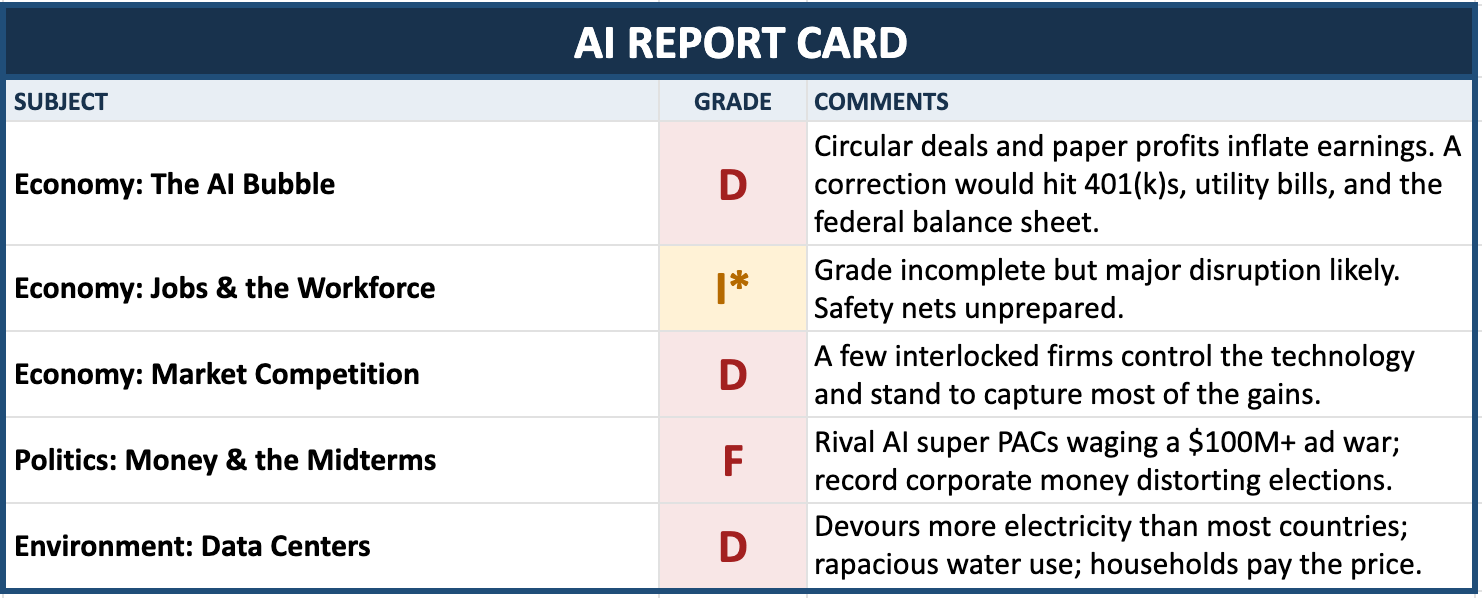
Start with the economy. A handful of large technology companies are fueling an AI bubble that is distorting large swaths of the global economy as I write in Tech Policy Press this week. Antitrust enforcement could let the air out of the bubble before the public pays via higher electricity bills and our retirement savings.
What AI will do to jobs remains uncertain, but it is likely to lead to major disruptions. Experts surveyed by the Bipartisan Policy Center expect generative AI to touch 18% of US work hours by 2030, up from roughly 2% today with a top-quarter estimate of more than 30%. There may well be inventions and productivity gains to come as a result of this technology. But whether everyone gets a fair share depends on who controls the technology. If a few interlocked firms continue to control and set the direction of AI technology, then the gains will flow to them. If AI is to be as disruptive as electricity, then let’s make sure that access to this technology is available to everyone at competitive prices.
There are also real risks for misuse, and we need guardrails to ensure that AI is used for good. We should not sacrifice competition to do this. Recent proposals for the US Government to take a stake in leading AI companies risks further entrenching the market power of these companies and inflating the AI bubble.
AI and Big Tech PACs are spending to thwart any meaningful guardrails or pro-competitive measures. Rival super PACs like Leading the Future, aligned with OpenAI, and Public First, allied with Anthropic, are among the biggest spenders in this year’s midterms, dropping tens of millions already with more than $100 million promised. Cryptocurrency, artificial intelligence, Big Tech and online betting corporations have collectively spent $294 million to date.
Some candidates are so fearful of the crossfire that many avoid discussing AI at all. Hundreds of millions of dollars have been wasted on an arms race to buy influence over how or whether the industry is regulated. We’ll cover more on that below.
Finally, there are environmental costs of mass adoption of AI technology as it is currently being developed. Data centers already devour more electricity than all but ten countries—about 448 terawatt hours last year, on track to double within four years. By 2030 AI data centers could consume as much water as the basic needs of 1.3 billion people, UN researchers estimate. Gas plants to power them are being approved in as little as 45 days without public hearings, while households foot the bill.
Power costs in Virginia are up 12 percent since early 2025 and going up further! UN Secretary-General António Guterres has asked AI companies to disclose their data centers’ emissions, water, and land use. So far, silence.
What we need is more competition and transparency. We need antitrust enforcement to unwind Big Tech’s crossholdings so AI firms compete independently and losses from risky bets fall on the risk-takers rather than the public. Finally, we need full disclosure of what data centers consume and what AI money buys in our politics.
We will continue to fight for democratic market control of this technology to ensure its benefits are shared by all of us, not captured by a few companies.
Thank you for reading and your support.
With regards,
Sumit Sharma
Executive Director, NextGen Competition
The End of Independent Agencies
The Supreme Court has sided with Trump by ending the independence of regulatory agencies when it decided that the president could fire FTC Commissioner Rebecca Slaughter. This gives further arbitrary power to a capricious President and creates regulatory uncertainty for all businesses. When the rules of the game can be changed on a whim or are applied selectively, markets stop working. The ruling further entrenches the market for favors and crony capitalism. It’s a massive blow to Congress and the principle that independent agencies should be insulated from political interference.. As Moria Donegan argues in The Guardian:
The Slaughter decision marks yet another expansion of the president’s power, yet another blow to Congress’s prerogatives, and yet another in a long line of attacks on the court’s favorite bete noir: the “administrative state”, that vast network of independent agencies and commissions, staffed by experts and bureaucrats and dully competent civil servants, whose hard, unglamorous work makes the federal government into a body that can regulate commerce, promote public health and safety, and ensure something like equal dignity and protection to its citizens – rather than the husk of cruelty and hierarchy enforcement that many of the justices would prefer it to be.
For Big Tech, the timing could not be better. Under Trump, the FTC has completely abandoned its responsibility to police competition, deceptive practices, privacy abuses and the growing market power of dominant technology platforms. Now, the agency charged with holding corporate power accountable, including its Republican Commissioners, is even more vulnerable to presidential pressure from an administration that has repeatedly cozied up to the very companies it is supposed to police.
The FTC was created to be a watchdog. The Court just made it that much easier for any president to turn it into a lapdog.
Anthropic and OpenAI Spend Millions on New York House Race
Why did AI companies pour more than $20 million into New York’s 12th congressional district? Because of candidates like Alex Bores, who helped make the race ground zero for the debate over whether artificial intelligence should face meaningful regulation.
Millions were spent against Bores, an AI safety advocate and New York assemblymember, in what became a proxy war over whether lawmakers should put guardrails around AI, data centers, worker displacement, and the growing power of the companies building the technology.
But even in defeat, Bores offered candidates a case study in how to mainstream the fight over AI regulation. He came in a close second in a crowded and expensive primary, showing that candidates should not be afraid of AI PACs, and that public skepticism of unchecked AI power is becoming a real political force.
“I didn’t get in this race to make a point about A.I.,” Mr. Bores said. He offered a message for fellow Democrats: “I urge them to look at this campaign not as a cautionary tale, but as a blueprint to take into the future.”
After winning the primary, Micah Lasher delivered a pointed message to OpenAI and Anthropic, saying he would not take his cues from either company “when it comes to protecting our kids, our jobs, our environment.”
Data Centers Dominate the Midterms
The fight over AI data centers is quickly becoming a central midterm issue. A new Consumer Reports survey finds Americans are deeply skeptical that Big Tech will actually pay for the energy costs its AI buildout creates. The survey found: 75% of Americans said they were “not too confident” or “not at all confident” that companies will follow through on these promises.
Majorities of both Democrats and Republicans remained skeptical of the pledge Amazon, Google, Meta, Microsoft, OpenAI, Oracle, and xAI signed at the White House with 83% of Democrats and 67% of Republicans lacking confidence in it.
Overall, only 4% of Americans said they were “very confident” that companies would follow through on their commitments.
From local communities pushing back on projects to high-profile Democrats calling for a pause until stronger safeguards are in place, the message is clear. Voters do not want their utility bills, water supplies, or neighborhoods treated as collateral damage for Big Tech’s AI ambitions.
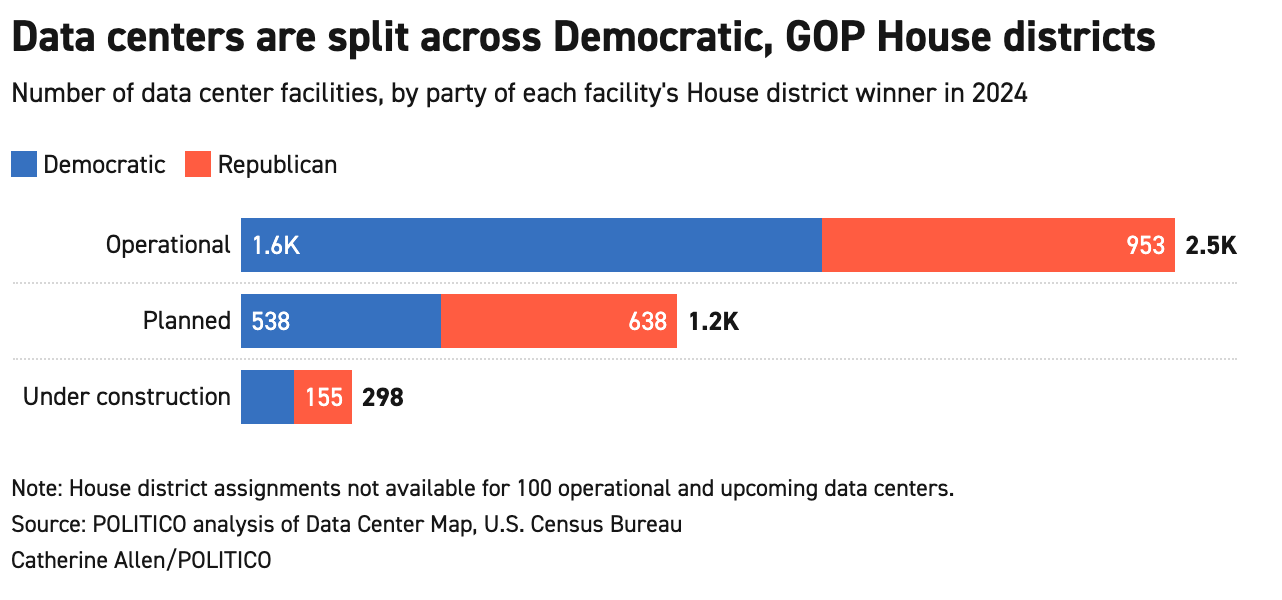
As Business Insider reports, “the industry’s exponential growth means that lawmakers from all parts of the country are now exposed to it, from the dense data center developments in the Virginia suburbs to the heart of the industrial Midwest.” The uniquely bipartisan hatred for data centers has become this midterm cycle’s most interesting battleground. We don’t think the millions spent on the midterms by groups tied to the artificial intelligence industry will outweigh the fear gripping voters over crippling energy costs across the rustbelt and heartland.
Other Competition News
Headlines from the past month you might have missed:
Microsoft Dodges Antitrust Heat: Remember the kid in the back of the class who would look down and hope the teacher didn’t call on them? That has been Microsoft since calls to break up Big Tech went mainstream. But according to The Verge, the tech giant’s time spent sinking into its desk chair and sweet-talking the teacher, or in this case the President, could be coming to an end. Lauren Feiner writes about the FTC’s ongoing investigation:
There’s no guarantee the investigation — which began under the Biden administration in 2024 and continued under President Donald Trump — will end in a legal complaint. After further investigative steps, FTC staff will choose whether to recommend filing one, and the agency’s two commissioners will take a vote. Should they approve a lawsuit, however, Microsoft may find itself back in a hot seat it occupied more than two decades ago, when a court found it had an illegal PC operating system monopoly.
Given that the Commission is down to two GOP commissioners and CEO Satya Nadella has cultivated a close relationship with Trump, it remains to be seen what, if any, heat Microsoft will face stateside. As Feiner points out, the European Commission, the UK’s Competition and Markets Authority, and the Japan Fair Trade Commission all have ongoing investigations into Microsoft’s cloud services.
Promises, Promises: Speaking of Microsoft, when the tech giant sought approval for its Activision merger, it leaned heavily on labor commitments to help sell the deal. We warned at the time that voluntary promises from Big Tech are no substitute for enforceable accountability, noting that after a 20-year effort by the labor movement, only a tiny fraction of Microsoft’s U.S. workforce had unionized. Now, Microsoft is laying off 4,800 employees, including roughly 1,600 in Xbox, with plans to cut about 20% of Xbox jobs by the end of the financial year. We take no joy in being right on this one. 😔
Global “Big Tech First” Agenda: Public Citizen is out with an interactive map showing where President Trump is “doing Big Tech’s bidding” around the world. The project finds that digital policies across 76 countries have been targeted by the administration, revealing what Public Citizen calls a “direct throughline from industry demands to Trump’s trade agenda.”
Though we do wonder if the industry is being shortsighted and undermining itself. No one likes being bullied.
Cue Europe’s Response: Much has been written lately about Europe’s push for “digital sovereignty” and a break from dependence on U.S. tech. While it remains to be seen how far those efforts can go, Europe is clearly trying. In Wired, Matt Burgess outlines an interactive timeline of actions taken to loosen the EU’s dependence on Big Tech, writing:
The moves are widespread—and growing. Last week, the European Commission launched its official long-term plans to rely less on US technology. The European Parliament has switched the default search engine on its devices from Google to the French alternative Qwant. Thousands of workers in the French government are using its own open-source office software—dubbed LaSuite—as officials aim to “break free” from dependence on American tech firms. An open-source documents offering from more than a dozen European tech companies, called Euro-Office, is due to launch imminently. Cities across the Netherlands, France, and Germany are all moving away from Microsoft Office and Google Docs.
More of the Same? The FCC’s general counsel is getting a new gig as DOJ’s AAG for Antitrust. Reuters reports that Adam Candeub, author of the FTC chapter in Project 2025, will step into the role vacated by Gail Slater earlier this year. In Project 2025, Cadeub was critical of Big Tech’s encroachment in government, writing:
The continued emergence of evidence documenting collusion—between the Big Tech internet platforms and the Biden White House and administrative agencies—to censor criticism, scientific fact, and uncomfortable political truths demonstrates this unfortunate development.
Now if that isn’t the pot calling the kettle black given where we are today…☕🙄
Copy, Paste, Compete: Apple is accusing Indian antitrust investigators of “copy-pasting” findings from other regulators in their App Store case. But here’s the reality check: regulators around the world keep reaching similar conclusions because Apple keeps engaging in similar conduct. From India to Europe to the United States, the core issue remains the same: Apple’s control over app distribution and payments gives it enormous power over developers, rivals, and consumers. 😵💫
Broligarchy Check-In: The Hill’s Miranda Nazzaro recently outlined where the titans of the tech industry currently stand with President Trump, from the erratic relationship between Trump and Elon Musk, to his newly rosy relationship with Mark Zuckerberg. If recent history is any guide, Big Tech’s relationship with the White House will remain transactional, volatile, and worth watching. 👀
Big Tech’s Next Conquest: As if monopolizing the tech industry isn’t enough, Big Tech is coming for Tinseltown. As The Hollywood Reporter’s Alex Weprin writes, YouTube is already dominating TV watch time, Meta is pushing Instagram deeper into longform video, and Amazon and Apple are making content decisions while cutting major deals across AI and entertainment. Traditional media companies are responding with megadeals of their own, from Fox-Roku to Paramount Skydance-Warner Bros. Discovery, in an effort to survive. But the broader concern is clear: as Big Tech gains more control over platforms, distribution, advertising, and content, the future of entertainment could increasingly be shaped by the same gatekeepers already dominating the rest of the digital economy. 😳
Until next month! In the meantime, follow us on X, BlueSky, and subscribe to our Substack for the latest on Big Tech, AI, and antitrust.