

Smartphones are essential to our modern digital lives. These are the computers that we carry around in our pockets and increasingly the primary device we use to access online services. Almost half the web traffic in the US originates on mobile devices and about 16% of American adults have a smartphone but don’t subscribe to a home broadband service.
However, unlike computers, the availability, functionality, and terms on which users can access services and service providers can offer services is controlled by two companies as illustrated below. In a new analysis, I estimate this gatekeeping costs US consumers on the order of $8.9 billion every year.
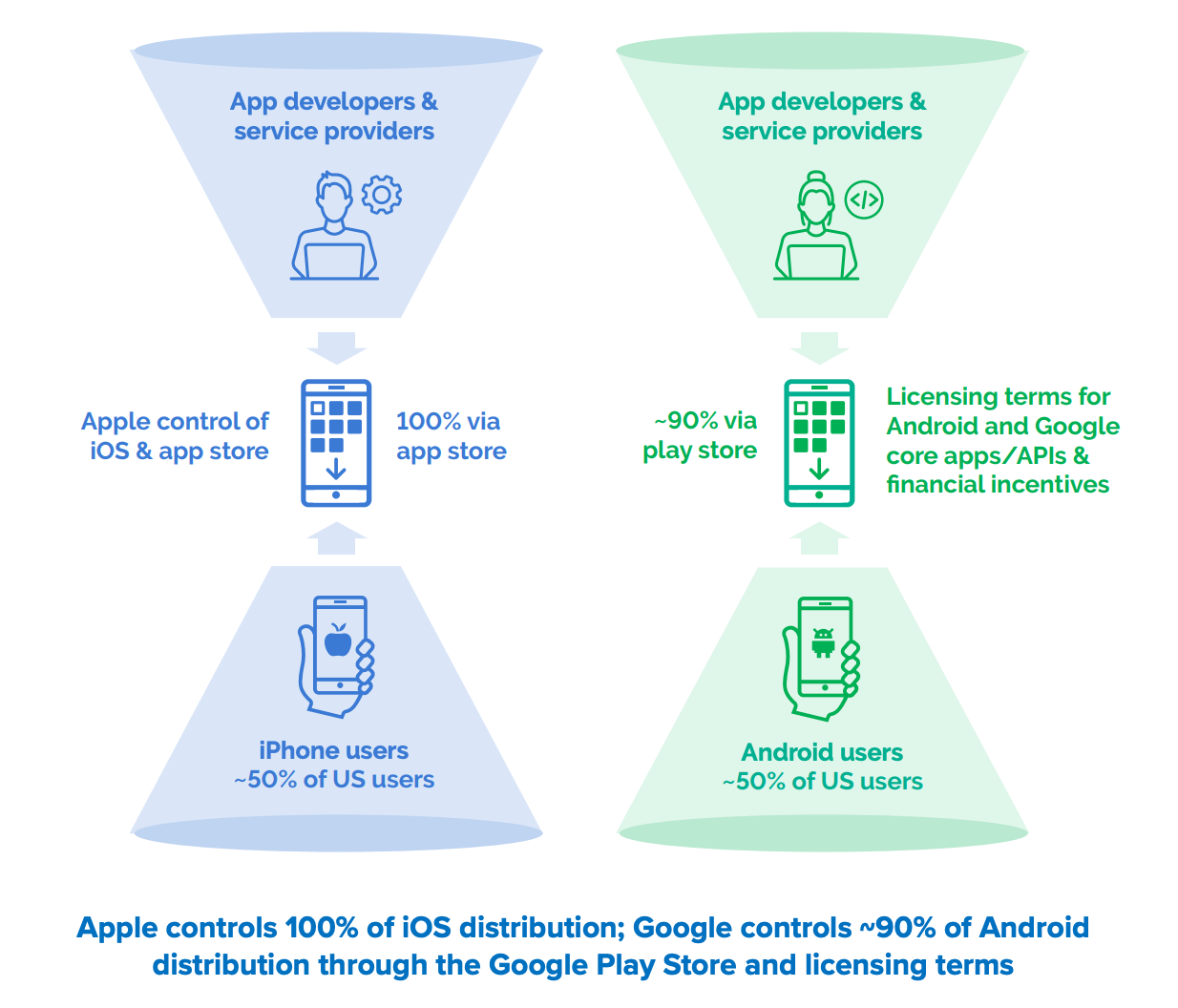
Source: Sharma, S, US Consumer Benefits of Unlocking Competition in App Distribution on Smartphones, July 2026.
In 2025, this monopoly control over distribution generated $117 billion in revenues for Apple and $49 billion in revenues for Google with margins of around 70-80%. Both companies therefore have the incentive (to protect these lucrative monopoly profits) and ability (the money) to stymie any reform, having done so in the past when there was overwhelming bipartisan support for regulating these app store gatekeepers. Today it seems they have a much easier job with House Judiciary leadership acting as a Big Tech lobbyist and the administration using trade policy at the behest of Big Tech companies to stop other jurisdictions from trying to address the vast market and political power of Big Tech. Even the current DOJ is in talks to settle the Government’s well-founded lawsuit against Apple.
We will continue fighting for democratic and competitive markets with multiple app stores, easier direct downloads from the web, super apps that operate across iOS and Android, and equivalent interoperability for third party apps and devices. This would enable developers, and small businesses to keep more of what they earn and for consumers to save money. Consumers would also benefit from new and increased app and service development, greater consumer choice in privacy and parental controls, and be able to freely choose the AI assistants and agents they want to use.
It would also mean that Apple’s and Google’s content policies do not dictate the information we can access on our smartphones. It would make it more difficult for the government to control the flow of information and tools to organize and protest. With two firms in control, a government that wants an app gone needs just two phone calls. For example, last October, at the Justice Department’s demand, Apple and Google pulled ICEBlock and similar ICE-sighting apps from their stores much like Parler was booted off in 2021. That is far too much power over speech and civic participation to leave in the hands of two companies.
Thank you for reading and your support.
With regards,
Sumit Sharma
Executive Director
NextGen Competition
Project 2025 Meets Pay-to-Play Antitrust
Last month, FCC General Counsel Adam Candeub was officially nominated by President Trump to serve as the DOJ’s new Assistant Attorney General for Antitrust, the role vacated by Gail Slater earlier this year. While many in MAGAland cheered the Project 2025 author’s nomination (including FCC Chairman Brendan Carr), consider us deeply skeptical. 🤨
In Project 2025, Candeub called for tougher federal competition enforcement against the tech industry. And yet, from his perch at the Federal Communications Commission…
He has watched as the Trump administration has cut sweetheart deals with the very tech executives he once suggested deserved more antitrust scrutiny.
He is tied to one of the more alarming episodes of this administration. DOGE’s access to sensitive FCC data, raising serious questions about whether confidential business information could be used to advantage powerful private interests like SpaceX and private equity.
Candeub has also complained loudly that companies like Facebook, Google, and Twitter, now X, have used Section 230 to build what he called a “censorship regime,” and he helped push the first Trump administration to seek new FCC rules for social media companies, for which the FCC has no authority to regulate.
Yet he has sat idly by as Carr has used broadcast licensing threats and repeated attacks on the First Amendment to bend the media toward Trump’s will. Carr is targeting ABC to attempt to bend the network’s will to heed Trump’s agenda. Thanks to an AI review by Disney, the ABC docket contains 142,721 comments of which 96.3% support the various ABC stations. If Candeub’s concerns were truly free speech and diversity of thought, this should trouble him.
But even putting all of that aside, Candeub is not set up for success. His chapter in Project 2025 reads:
“Despite their enormous size, they have avoided significant antitrust liability or prosecution. The reasons for this are not entirely clear.”
Hindsight is 20/20. The reason now is CRYSTAL clear: Donald J. Trump.
Candeub may talk tough about Big Tech, but this administration’s record tells a different story. We saw the same enthusiasm for Gail Slater only for her to be met with the reality that this Administration is more interested in cutting corrupt deals than protecting consumers and holding Big Tech executives to account.
Little Tech Comes to Washington
In a rare moment of good news on the tech front, last month marked the launch of Washington, D.C.’s Little Tech Association (LTA). With over 200 members, the group’s mission highlights “championing open systems, open standards, and open infrastructure so that the tools people rely on work together and no gatekeeper decides who gets a shot.” 👏
NextGen Executive Director Sumit Sharma was on hand for the launch, where Harry Godfrey, LTA Executive Director, said:
Founders, builders, and digital innovators - i.e. Little Tech - are the lifeblood of the tech industry. They drive innovation, build great products, and disrupt the status quo. And yet, for too long, little tech’s voice in Washington has been stifled by Big Tech and their allies. We intend to change that, advancing free market policies that help startups grow, compete, and thrive.

Photo Credit: Mariah Miranda
We love to see other voices enter the arena to help counter Big Tech’s influence in D.C. and in state and local policy debates across the country. Speaking of which, LTA commissioned a poll that echoes our concerns. The poll, a YouGov survey of around 1,200 adults, found that 71% believe the tech companies have too much power, with just 2% saying they have too little power.
More than two-thirds of Americans (68%) said they support state and federal agencies using existing antitrust laws against tech companies, with only 3% opposed.
Nearly the same share (67%) supported bipartisan efforts to strengthen such laws, with just 4% against these kinds of moves.
Ninety percent of Americans reported being concerned with how large corporations are collecting and using their personal data, with 48% describing themselves as “very concerned.”
Other Competition News
Headlines from the past month you might have missed:
Achievement Unlocked: Broken Promises: In early July, Microsoft announced 4,800 layoffs, with cuts falling largely across its Commercial and Xbox organizations. Xbox CEO Asha Sharma described the shakeup as the “most significant restructure in Xbox history,” a remarkable admission from a company that sold its Activision Blizzard acquisition as a win for workers, gamers, and the future of the industry. Less than three years later, that pitch looks increasingly hollow. 🤦🏻♂️
These cuts come on the heels of the tech giant eliminating 1,900 Activision Blizzard and Xbox jobs in January 2024, and another 650 roles from its Xbox Games unit later that year.
For workers, the post-merger reality has been consolidation, restructuring, and repeated layoffs. For antitrust enforcers, it is another reminder that voluntary Big Tech promises are not accountability.
Google vs. EU: The European Union smacked Google with a $1 billion fine (€890 million) for two separate violations of the Digital Markets Act: favoring its own Shopping, Hotels, and Flights services in search results, and restricting Android developers from recommending alternatives outside the Play Store for payment. Google now has 60 days to change its policies or lose even more cash. 💸
Tech Sovereignty, À La Carte: Much has been written about the European Union’s uphill climb to reduce its dependence on U.S. tech, particularly given Big Tech’s cozy relationship with a volatile U.S. President. Writing with a healthy dose of reality, Jim Tankersley and Mark Landler of The New York Times highlight how countries like France, Germany, and the Netherlands are trying to move forward anyway:
“One hundred percent autonomy in digital services is not at this stage something that is feasible,” said Anne Le Hénanff, France’s minister for artificial intelligence and digital affairs. “We just need to decide what we don’t want to be dependent on.”
So far, that means France developing an alternative to Zoom, Germany focusing on an AI platform, and the Netherlands announcing plans to create government-controlled data centers. The push is still early, fragmented, and complicated, but the underlying message is clear: Europe increasingly sees dependence on U.S. tech giants not just as a market problem, but as a strategic vulnerability. 😳
From the FTC to NYC: Before joining New York City Mayor Zohran Mamdani’s administration, former FTC Chair Lina Khan sat down with Paul Krugman to discuss the infiltration of AI, where states and municipalities are stepping up as the federal government “backslides,” and one overlooked competition fight we should all be watching. 👀
Doctor(ow)’s Diagnosis: In a long-form piece for Medium, author and journalist Cory Doctorow argues that Big Tech has escaped a brief moment of antitrust vulnerability by tightening its grip on Washington. He traces how Biden-era enforcers helped fuel a global trustbusting movement, only for the Trump administration’s coziness with tech giants to weaken U.S. leadership and embolden monopolists.
Doctorow’s prescription: don’t wait for federal enforcers. State attorneys general and international regulators can coordinate, share evidence, and put pressure on dominant platforms. 💪🏼
OpenAI’s Terrible, Horrible, No Good, Very Bad Year: In The Verge, Hayden Field writes how things couldn’t get worse for OpenAI founder and Trump acolyte Sam Altman…until they did with Apple’s lawsuit against the ChatGPT creator:
“The lawsuit is yet another obstacle for OpenAI, which has had a rollercoaster six months full of drama with rivals over US military red lines, protests over contract with the US government, a drawn-out legal battle with former OpenAI co-founder Elon Musk, and a race with Anthropic over which frontier lab would be first to IPO — not to mention a laundry list of lawsuits, a few of which came from Musk himself. Another still ongoing lawsuit was brought by the family of Adam Raine, a 16-year-old who died by suicide after confiding in ChatGPT. And then there’s the long-running suit brought by The New York Times and other publishers against OpenAI, alleging copyright infringement.”
Field sums up the laundry list of problems quite well, highlighting why this particular lawsuit may be different: it could be a “years-long” fight. 😳
Until next month! In the meantime, follow us on X, BlueSky, and subscribe to our Substack for the latest on Big Tech, AI, and antitrust.