


Welcome to NextGen Competition’s monthly recap, delivering insider insights on antitrust battles, industry shakeups, AI trends, and more.
Did a friend forward this to you? Get the latest insights in your inbox monthly by subscribing here!
Subscribe Here | Twitter | Bluesky | Website | Research | Contact | Donate
Amazon’s dystopian vision of an interconnected AI-enabled mesh network of cameras constantly surveilling our neighborhoods is the basis of its latest service, ‘Search Party’, evangelized by its CEO Jamie Siminoff. Its Super Bowl ad brought this panopticon into focus.
Amazon Sidewalk, the low-bandwidth wireless network that underlies Ring’s “Search Party” feature, now blankets over ninety percent of the U.S. population. The feature is also turned on by default, meaning millions of cameras across the country are scanning their surroundings without their owners or passers-by having actively chosen to participate.
Even fewer consumers are likely aware that Amazon then repurposes Sidewalk, built using home Wi-Fis, Ring cameras and Echo devices, and offers this connectivity to third party manufacturers of asset trackers, motion detectors, and other connected devices. A fascinating study by researchers in the Netherlands explains how this enables even more data to be collected from our homes and neighborhoods, further undermining privacy.
It also allows Amazon to dictate standards and protocols for a whole ecosystem of connected devices, and funnel them to its own cloud services (AWS). It’s already removing Wi-Fi and Z-Wave (open standards) from its latest smart home sensors and will soon be pushing the industry to adopt Amazon’s proprietary service—if they want to keep integrating with Ring. This leverage allows Amazon, the world’s largest company by revenue, to further entrench and expand its market power from the cloud (AWS) and its e-commerce platform (Amazon.com) into our homes.
This dynamic should concern anyone who cares about competition. The 2023 Merger Guidelines issued by the Department of Justice and the Federal Trade Commission warn specifically about consolidation trends that allow dominant firms to gain bargaining leverage over trading partners, triggering cascading consolidation across an industry and increasing barriers to entry. Amazon’s Sidewalk playbook fits this pattern precisely. By controlling a network that reaches into ninety percent of American homes, and by conditioning access on compliance with its own proprietary standards, Amazon doesn’t just sell doorbells—it positions itself as the infrastructure layer for all consumer IoT.
Yet all this still misses another cost of Amazon’s vision of an automated and impersonal neighborhood. As the Super Bowl ad implies, you just press a button on your phone, and the algorithm handles the rest. But clicking a notification does not build community. These algorithms isolate and atomize. What we need more of today is going out and having those awkward conversations and interactions face to face. When we outsource our neighborhood to algorithms, we lose the excuse to walk the block, to strike up a conversation, to build the kind of trust that no AI can replicate.
Some political leaders recognize this challenge. In New Hampshire, congressional candidate Carleigh Beriont is running a campaign entirely without social media, going door to door to have the kinds of conversations that algorithms cannot mediate.
The Super Bowl ad asked us to believe that surveillance is safety and that clicking is caring. We should know better.
Thank you for reading and your support.
With regards,
Sumit Sharma
Executive Director
NextGen Competition
Washington Is Catching Up on Acquihires
NextGen Competition has long sounded the alarm about Big Tech’s merger workarounds. This month, Senators Warren, Wyden, and Blumenthal urged the FTC and DOJ to scrutinize AI “acquihire” deals for potential antitrust violations. They called out Meta’s $14.3B Scale AI play, Google’s $2.4B Windsurf deal, and Nvidia’s $20B Groq purchase. The letter reads:
“[These deals] function as de facto mergers, allowing the companies to consolidate talent, information, and resources, all while apparently attempting to bypass the scrutiny typically applied to mergers and acquisitions.”
Sound familiar? It’s because NextGen Competition has been leading a coalition making exactly this argument for nearly two years. In February 2024, NextGen Competition led a coalition letter applauding the FTC initial inquiry into Big Tech’s AI investments, including Microsoft’s relationship with OpenAI. That September we called on the FTC to investigate Amazon’s reverse acquihire of Adept. And last August, we led a twelve-group coalition urging the FTC to block Meta’s $14.3 billion Scale AI deal.
The deals are all cut from a simple playbook: Avoid getting labeled as a merger and avoid the scrutiny. FTC Chair Ferguson has acknowledged the trend, signaling the agency is “beginning to look very closely” at these structures. It’s a start, but the question is whether Ferguson will act or if for reasons we explore in the next lead story, it won’t matter. Either way, we’ll keep pushing.
Gail Slater’s Cardinal Sin: Taking Antitrust Seriously
Gail Slater’s abrupt departure as Trump’s antitrust enforcer unfortunately didn’t surprise us. Her exit offers a revealing window into this administration’s approach to antitrust enforcement.
From the start, Slater was working at the margins. While she pushed for the ability to police mergers without political interference, others, including Pam Bondi and her deputy Todd Blanche, made clear that neither Slater nor career antitrust staff would be calling the shots. The clashes began almost immediately. She wasn’t the first casualty and is unlikely to be the last.
When her team raised concerns about a proposed settlement in Hewlett Packard Enterprise’s $14 billion acquisition of Juniper Networks, Slater was reportedly overruled by Chief of Staff Chad Mizelle, who greenlit the deal. The next day, DOJ quietly dropped its challenge to the Amex GBT–CWT merger, a merger backed by Ballard Partners, Attorney General Pam Bondi’s former lobbying firm.
Slater began as Vice President Vance’s hawkish pick, a genuine skeptic of Big Tech and an advocate for strong antitrust enforcement. For a brief moment, the anti-monopoly movement dared to hope. But that hope looks naive in retrospect.
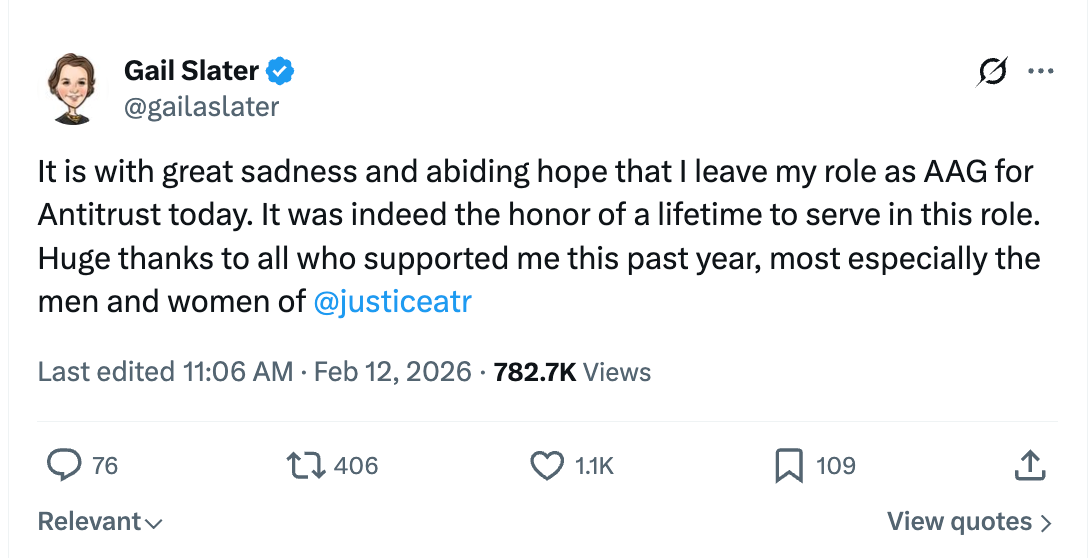
Slater’s exit confirms what we at NextGen Competition have been warning about all year… this administration’s golden rule is simple. Those who pay make the rules. Apple, Google, Meta, Microsoft, and Amazon have collectively spent over $100 million lobbying Washington and donated lavishly to Trump’s inauguration and causes. While cases and investigations are continuing, will these companies really face meaningful antitrust scrutiny amid all that spending?
The uncertainty is real. The Google search monopoly remedy—already a disappointment—now faces an uncertain appeal. Cases against Apple, Amazon, and Google are in similar limbo and may follow the same path: cosmetic remedies that tinker around the edges rather than dismantle monopoly power.
Even though Washington may not hold Big Tech accountable, the states increasingly will. State attorneys general have become the most reliable front in the antitrust fight. Last November, NextGen Competition joined a coalition led by the American Economic Liberties Project urging state AGs to appeal the Google remedies decision. On February 3rd, they did just that.
They Perfected the System in China. Now They’re Deploying It Here.
American tech companies spent two decades helping China build one of the world’s most extensive surveillance systems. IBM licensed analytics technology used in an AI-driven predictive policing app targeting Muslim minorities in Xinjiang, China. Microsoft, Oracle, and Cisco supplied tools to Chinese police. The model didn’t stay in Xinjiang. Researchers have documented it spreading across China, to Gaza, and into parts of Africa.
Now those same companies are bringing that mass surveillance playbook to the U.S. ICE has access to driver’s license data for roughly three-quarters of American adults. It’s deploying facial recognition apps for biometric identification in the field. Palantir signed a $30 million contract to build something called ImmigrationOS, an AI system designed to identify, track, and deport suspected noncitizens. It runs on Microsoft’s Azure, which also hosts ICE’s most sensitive unclassified data. Amazon Web Services carries much of the rest.
And as this domestic mass surveillance apparatus grows, the Trump Administration is making it harder than ever to track. According to 404 Media, this month the “government stopped supporting FPDS.gov, an indispensable resource for finding what ICE, the FBI, and every other agency is buying.” Its replacement is deliberately harder to search, harder to navigate, and less transparent making it nearly impossible for journalists, researchers, and citizens to see what’s being built.
Other Competition News
Headlines from the past month you might have missed:
Data Center Duels: In 2026, if there’s an issue that unites Republicans and Democrats, rural and urban, working families and local officials, it’s disdain for Big Tech’s AI data centers. As Anvee Bhutani and Amrith Ramkumar wrote in The Wall Street Journal earlier this month, communities around the country are seeing unlikely allies coalesce around their efforts to delay or dismantle plans for data center construction. As former Democratic Oklahoma congressman Brad Carson says in the piece, “There is a growing rebellion. It’s cutting across every demographic and every partisan line that otherwise seems to divide the nation.”
The article cites a study from Data Center Watch, which found that twenty projects, worth $98 billion, were postponed or prevented in just the second quarter of 2025.
Worried about data centers in your community? 🤔 Check out the American Economic Liberty Project’s detailed brief on the issue, covering taxpayer burden, the use of NDAs, and the policy steps needed to combat Big Tech.
Two Steps Forward, One Step Back: The European Union continues to spar with Big Tech after accusing Meta of restricting access to competing AI assistants on WhatsApp. But officials insist it has nothing to do with President Trump and everything to do with preserving competition, as Competition Chief Teresa Ribera told Bloomberg:
“The abuse of a dominant position in a given market that prevents any other alternative for final users is not good news for anyone… it’s not good news in Europe; it’s not good news in the United States,” she said. “This is the message that we wanted to send to Meta.”
Additionally, the EU lodged an antitrust complaint against Google over its AI Overviews, who according to publishers, is using their content to generate summaries without paying them. 😳
But, the EU also cleared Google’s $32 billion acquisition of Wiz this month, further integrating cybersecurity into Google’s Cloud, tightening bundling in a market already dominated by tech giants.
Appeal or Agenda? In what should have been routine in a long-running antitrust battle, the FTC’s appeal of its Meta loss has taken on a distinctly political hue. As Lauren Feiner reports in The Verge, the agency didn’t just signal disagreement with Judge James Boasberg’s ruling, it publicly attacked him, reigniting impeachment chatter from Trump and allies in Congress. That’s not standard fare for an “independent” regulator.
But as former FTC Chair Bill Kovacic noted in the article, “My sense is the audience for that comment was the White House.” Shocker. When antitrust starts looking like leverage, or loyalty signaling, it stops looking like law enforcement. 🫠
On that same note, the New York Times Editorial Board is out with a scathing piece on the President’s effect on independent regulators like the FTC and FCC, writing:
“The Trump administration has ruined that independence. President Trump’s appointees have weaponized the agencies and transformed them into instruments of ideological enforcement. The changes not only threaten their core responsibility to ensure a fair business playing field but also directly undermine the First Amendment.”
“Tech Insider” to “Truth-Teller:” In a revealing TIME profile, Billy Perrigo spoke with Dex Hunter-Torricke, former Mark Zuckerberg speechwriter and Big Tech insider on his time in the industry, what he regrets about “only telling half the story,” and his thoughts on the future of AI:
“There is no plan. I do not believe for a second that winging it through the biggest economic and technological transition in human history is a responsible way to do things…we are sleepwalking into disaster.”
In an effort to change this, Hunter-Torricke recently launched The Center for Tomorrow, which Politico reports will “bring policy makers, researchers, industry figures and civil society groups together to devise ways to safely prepare the world for AI.”
Dumping Big Tech: Now that Valentine’s Day is behind us, it’s time to dump that toxic, co-dependent partner: Big Tech. Looking for advice on how to do that? The Guardian’s Steve Rose has you covered, with recommendations for everything from browsers and email to shopping and AI. Time to leave Big Tech in the dust. 💨
Standby For Our Next Q&A: We’re gearing up for the second entry in our Q&A series. Any guesses on who’s next? 👀 In the meantime, catch the first installment with attorney, advocate, and Illinois’ 7th District congressional candidate Reed Showalter here.
Until next month! In the meantime, follow us on X, BlueSky, and subscribe to our Substackfor the latest on Big Tech, AI, and antitrust.