

It’s open enrollment season for millions navigating the Affordable Care Act and for monopolists currying favor at the White House. And what a contrast! We have an administration that is happy to protect narrow monopoly business interests but not lift a finger to make healthcare affordable for millions.
But when you are making billions via corrupt dealings, you can call affordability a hoax and experiment with economically illiterate tariff policies that raise prices and decimate small businesses.
Big Tech has been at the front of the line of supplicants to avoid scrutiny and receive special treatment from the Trump administration:
Google, Apple, and Amazon would like a weak settlement in their antitrust cases. (Court decisions have found that Google illegally maintains its monopoly in general search and digital advertising, and there are active antitrust cases against Amazon and Apple).
Meta wants to be free to continue to target children and teens without any regard for their safety while profiting from 15 billion scam ads a day.
Microsoft would rather not face scrutiny of its various AI partnerships and investments like those with OpenAI.
OpenAI would like to con the government into believing that it is too important to fail and deserves a bailout.
Google, Amazon, Microsoft, Meta, and Apple already have dominant market positions in key inputs required to develop Gen AI and control ecosystems of products and services where they can deploy and commercialize this technology. They would rather not have acquisitions scrutinized. And the administration has obliged, for example by waiving through Google’s acquisition of Wiz.
This is not the way.
We will continue our fight to hold this administration and Big Tech accountable as we have done consistently and forcefully throughout this past year.
Until then, wishing you all a Merry Christmas and Happy New Year!
Thank you for reading and your support.
With regards,
Sumit Sharma
Executive Director
NextGen Competition
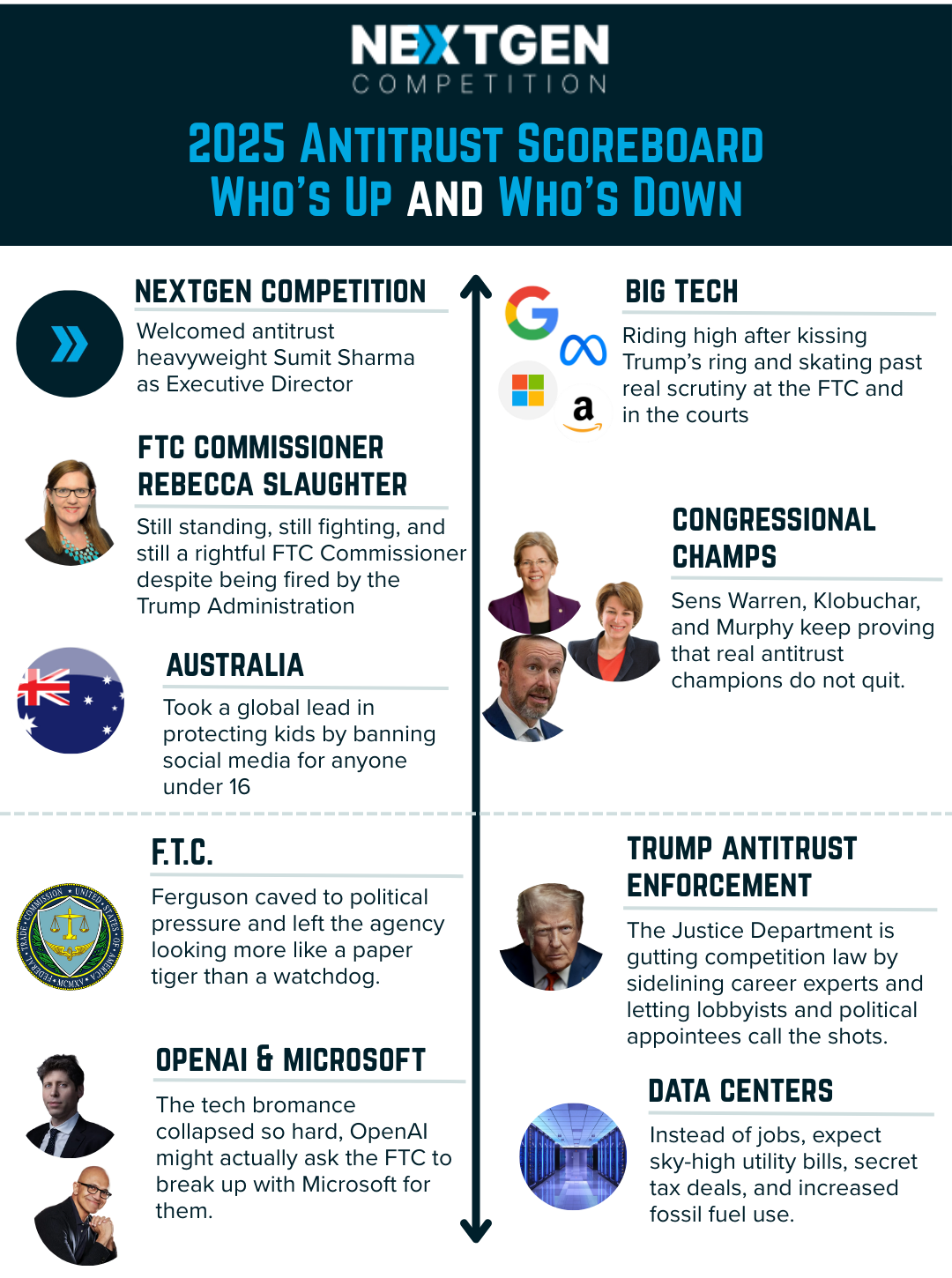
2025 Antitrust Scoreboard
Leadership in Action: Defending Institutions, Elevating Voices, and Growing Our Movement
In a year that tested the independence of our institutions and the strength of our antimonopoly movement, NextGen Competition rose to the occasion. From defending the Federal Trade Commission’s independence in the face of unprecedented political interference to welcoming new leadership and spotlighting future champions in Congress, our commitment to strong, accountable leadership has never been clearer.
We proudly joined over 40 privacy, consumer protection, and competition groups in filing an amicus brief in Slaughter v. Trump, urging the Supreme Court to uphold decades of precedent and reinstate FTC Commissioner Rebecca Slaughter after her illegal removal. We stood firmly behind both Commissioners Slaughter and Bedoya, who have spoken out forcefully against the President’s power grab, warning of the dangerous precedent it sets for corporate accountability.
This year also marked a new chapter for NextGen Competition, as we welcomed economist and policy expert Sumit Sharma as our new Executive Director. Sumit brings deep experience from his time at Consumer Reports and across the public and private sectors, where he has long fought to ensure markets work for the many, not the monopolists. We thank George Rakis for his leadership and continued service on our board as Executive Director Emeritus.
Looking to the next generation of champions, we launched our Q&A series with a timely conversation with Reed Showalter, a former DOJ and FTC attorney now running for Congress in Illinois. His campaign reflects the kind of bold, informed leadership this moment demands.
In 2025, we protected institutions, welcomed new leadership, and doubled down on the people who will lead the next phase of the antimonopoly movement.
Exposing the AI Power Grab: Big Tech’s AI Empire
This year, NextGen Competition helped lead the charge to expose and challenge the consolidation of power in artificial intelligence, a space increasingly dominated by the same corporate giants who already control search, cloud, commerce, and communications.
We started early with a letter to the House Judiciary Subcommittee, underscoring the transformative potential of generative AI-based foundation models and advocating for strong policy guardrails to minimize harms like privacy breaches, misinformation, and malicious uses.
As Big Tech scrambled to lock up AI infrastructure behind closed doors, we spoke out. In August, we joined over 100 experts and organizations urging OpenAI to increase transparency around its restructuring plans. And when Meta made a $14.3 billion play for Scale AI, we led a coalition letter calling on the FTC to block the deal and prevent Meta from dominating the data pipelines that fuel generative AI.
Our blog, DeepSeek Blows Up Big Tech’s Monopoly Myth, told the truth Silicon Valley doesn’t want Washington to hear. While Big Tech has spent years pushing the false narrative that antitrust enforcement would give China an edge, DeepSeek’s rapid ascent shows that China’s AI advancements are happening regardless.
Meanwhile, the cracks in Big Tech’s AI alliances are starting to show. OpenAI is now reportedly considering asking the FTC to investigate Microsoft, its own billion-dollar partner, over anticompetitive behavior. We’ve warned that these so-called “partnerships” are really acquisitions in disguise. Now even Sam Altman seems to agree.
As we enter 2026, one thing is clear: Big Tech’s AI dominance is not inevitable, and we’re not backing down from the fight to keep innovation open, hold tech giants accountable, and work to ensure a competitive market.
Enabling Competition: Countering Big Tech’s Influence Operation
We began 2025 with a new presidential administration, one we were cautiously optimistic would continue to tighten the reins on monopolies. We were encouraged by AAG for Antitrust Gail Slater, for example, who we thought would continue the fight of her predecessor. Sadly, the year went from disappointment to disappointment, which led to a more active year than ever for NextGen as we called out the pandering for what it was: Big Tech flattery.
Earlier in the year, we were deeply alarmed by the sheer number of billionaires like Elon Musk, Jeff Bezos, Mark Zuckerberg, Sundar Pichai, and Tim Cook in the Capitol rotunda when President Trump took the oath of office, authoring a blog calling the behavior out for exactly what it was. The “oligarchs only” section was clearly in recognition of their donations of $1 million each to the President’s inaugural fund, with some even hosting lavish celebrations with high-profile Republican donors.
In May, we joined fifteen other public interest organizations calling on newly-installed FTC Chair Andrew Ferguson to resist political pressure and preserve the agency’s ability to hold powerful corporations accountable.
Additionally in May, Sumit had the opportunity to speak to Omar Gallaga at CNET about the app developer class action suit against Apple after the company refused to comply with court orders on its monopolistic practices in subscriptions and in-app purchases.
Later in the summer, Sumit didn’t mince words in The Well News when he called out the DOJ for “gutting competition” in the form of “pay-to-play” antitrust. He pointed to the HPE-Juniper approval over staff objections, the firing of senior antitrust deputies, and the sudden reversal in the AmEx GBT–CWT case as part of a pattern that rewards lobbyists closely connected to the attorney general over consumers and competition.
In the fall, we also signed on to letters to both the FTC and state attorneys general, the former urging the agency to investigate the market structure and systemic risks posed by dominant cloud providers like Amazon, and the latter, imploring state officials to appeal the Google remedies decision.
When the disappointing Google remedies decision was released, Sumit published an analysis in Tech Policy Press explaining why the court’s approach fell far short of restoring competition. He warned that allowing Google to keep paying for default search placements all but guarantees its dominance will continue, and urged the DOJ to appeal and pursue remedies that directly dismantle Google’s monopoly instead of betting on AI to solve the problem.
Most Americans were appalled in November when newly released photos showed complete demolition of the East Wing at the White House to make way for President Trump’s ballroom. It should surprise no one that Apple, Amazon, Google, Meta, Microsoft, and Palantir were among the top donors on the White House list. We applauded Rep. Bennie G. Thompson for sending a letter to over 20 corporations demanding answers, “including the amount of their donations and whether they had been promised anything in return.”
Finally, in Common Dreams, Sumit lamented that under Rep. Jim Jordan, House Judiciary hearings have devolved from bipartisan investigations into corporate power to “theater,” “viral hearings,” and a “waste of taxpayer dollars,” with Rep. Jordan himself earning the moniker of Big Tech’s most effective lobbyist in Congress.
NextGen Competition wishes you and yours a wonderful holiday season and a bright start to 2026. 🎄🕎
We’ll keep fighting, and we hope you’ll stay in the fight with us. In the meantime, you can always find us on X, Bluesky, and Substack, where we’re tracking Big Tech’s power grabs, exposing fake “partnerships,” and spotlighting real solutions to protect competition and innovation.
Let’s make 2026 the year we finally turn the tide. 💪🏼