


Amazon exemplifies the potential harms of unchecked monopoly power.
It is the new (online) company town that can control and dictate the terms for everyone it deals with. Three separate lawsuits filed by the FTC and various State AGs spell out harms to advertisers, delivery drivers, and sellers and consumers.
As these complaints allege, sellers pay more to Amazon because it secretly changed how it ran auctions to inflate advertising charges on its platform. At the same time, it used its position as a must-have e-commerce channel to manipulate its search results—moving away from organic search results—to effectively force sellers to advertise and use Amazon’s own delivery service to be highly ranked.
This matters because if a seller is demoted in Amazon’s search results, its chances of making a sale drop dramatically, as most users tend to purchase products recommended by Amazon or those that appear on the first page of search results. These schemes allow Amazon to charge sellers ever-increasing commissions and fees and push consumers to paid search results that might not be the best deal for them.
And because exploiting sellers and consumers isn’t enough, Amazon has also used its position as the monopoly buyer of delivery services to impose low compensation and poor conditions on drivers.
These Amazon cases highlight the importance of distinguishing between the many advantages that the internet provides like better access to information, e-commerce, and the ability to stay in contact with our social networks from the companies that currently dominate these activities—Google, Amazon, and Meta.
Making this distinction is essential to dismiss the spurious claims by these companies that any effort to curb their monopoly power and resulting harm will lead to the deterioration of useful, beneficial services.
On the contrary, curbing Big Tech monopolies is not only essential for consumers, businesses, and workers to fully benefit from the internet and newer technologies like AI, but also to stop monopoly money from corrupting our politics.
Thank you for reading and your support.
With regards,
Sumit Sharma
Executive Director
NextGen Competition
NextGen Competition Applauds Bipartisan Action Against Amazon’s Advertising Toll Road
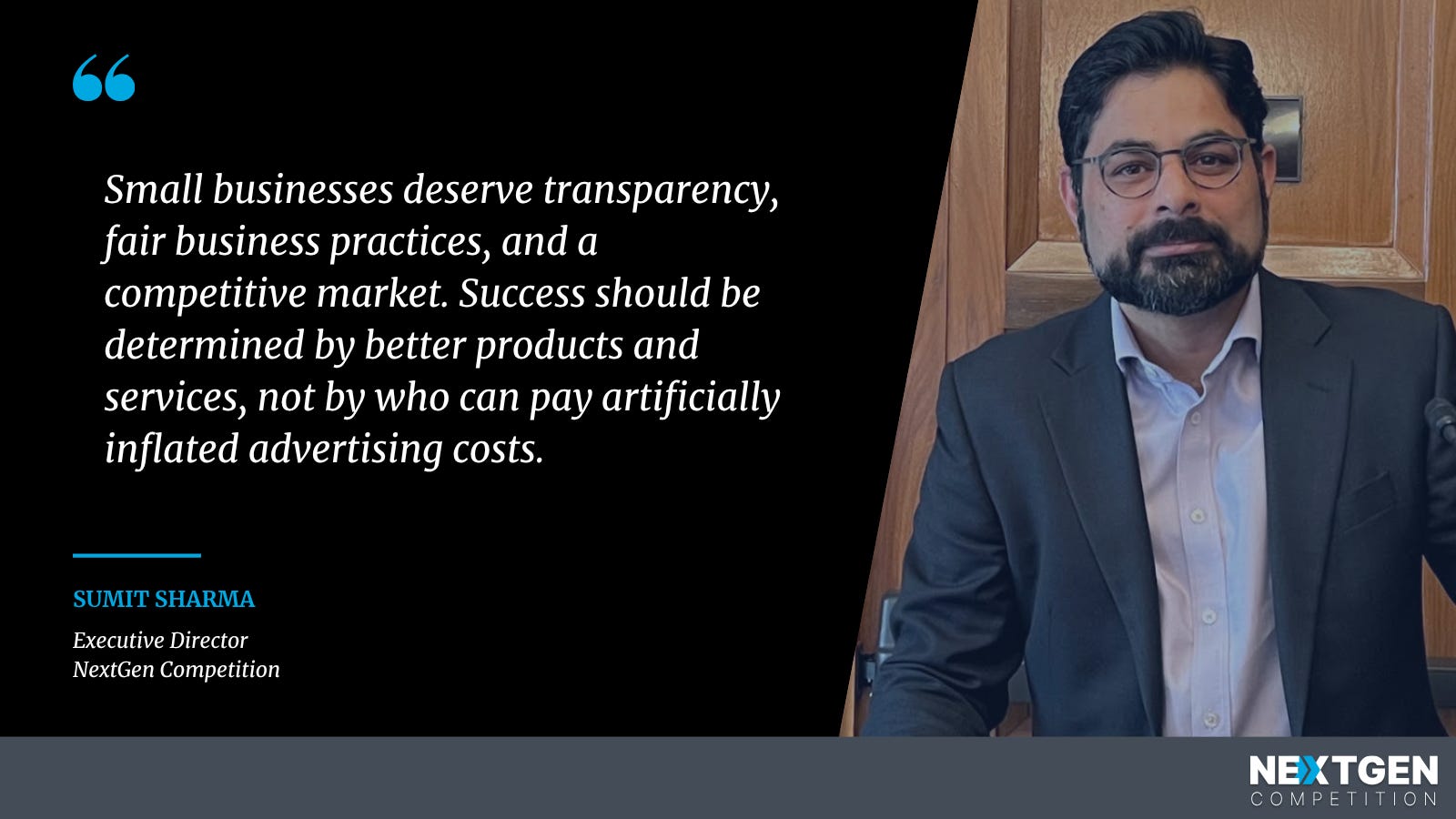
NextGen Competition commended the FTC and a bipartisan coalition of state attorneys general for seeking to hold Amazon accountable over allegations that it deceived advertisers by secretly raising the minimum price for promoted ads.
As Sumit noted, Amazon’s monopoly control over online commerce gives it enormous power over the small businesses that depend on its marketplace and makes fair competition impossible.
Big Tech Did the Impossible: United Americans Against Data Centers
What started as local fights over zoning, electricity, and water has quickly become one of the clearest political flashpoints of the AI era. Across the country, communities are pushing back against Big Tech’s data center gold rush, raising concerns about secretive deals, higher utility bills, strained grids, water use, land grabs, and whether the promised jobs and economic benefits will ever materialize.
As Todd Paglia argues in Common Dreams, the right way to build support for data centers would be to focus on a few basic – yet slow – ingredients like transparency, local benefits, clean energy, and respecting people and their communities. Big Tech had other ideas…
Big Tech has done the impossible—they’ve united people from across the political spectrum around a singular issue: against data centers and AI. The mega rich, unconcerned with the struggles of everyday Americans—has instead delivered a masterclass on how to manufacture dissent.
That backlash is now moving from town halls to the campaign trail. POLITICO called it the industry’s “oh sh*t” moment, while The New York Times reported that data centers have become “unlikely fault-lines in the broader fight over an A.I. revolution that is remaking the global economy and threatening to disrupt the job market.”
The politics are not hard to understand. Voters are responding to a broader sense that companies like Google, Microsoft, and OpenAI are asking the public to subsidize their AI ambitions while communities are left holding the bag. Anna Greenberg, a veteran Democratic pollster, told The New York Times that the movement is “very much a bottom up, organic movement,” with data centers becoming “a physical manifestation” of broader skepticism toward Big Tech and AI.
That is why this issue has the potential to become much bigger than a fight defining the midterms. Data centers make the abstract harms of Big Tech concrete. They turn monopoly power into higher electric bills. They turn AI hype into water fights, land-use battles, and closed-door subsidy deals. They force communities to ask the most basic political questions: who pays, who profits, and who gets ignored?
For Democrats, that presents an opening. The party has spent years searching for a durable way to reconnect economic populism, climate politics, labor, rural communities, young voters, and distrust of concentrated corporate power. The data center fight puts all of those issues together. But only if Democrats get it right.
And Republicans are in real trouble. The backlash to data centers is not coming from one ideological camp. It is coming from communities that feel ignored, overruled, and asked to sacrifice their land, water, and utility bills for Big Tech’s AI boom. Yet the man who shapes MAGA politics is not listening to those concerns. He is berating them.
“The only reason that communities throughout the U.S.A. should not want Data Centers is if they want to end up being backwards and poor,” Trump wrote. “If we kill the Golden Goose, you will only have yourselves to blame.”
That is a remarkable closing argument to voters worried about who pays for the AI future. The party that understands that these communities feel ignored has a chance to build something lasting. And the party that mocks those communities is choosing Silicon Valley over the people living with the consequences.
Other Competition News
Headlines from the past month you might have missed:
It’ll Never Be Enough: In UnHerd, Kristina Murkett opines on how it may appear that fines are a means of holding Big Tech accountable, it’s largely just “the cost of doing business” to tech giants. There’s no incentive to eliminate their monopolistic behavior. Murkett argues we need to do more:
We also need to address Big Tech’s illegal market dominance, and the fact that each of these behemoth companies has effectively become a monopolist that controls a portion of the internet — the world’s most important and irreplaceable infrastructure…None of them will relinquish their power, influence and — most importantly — profits without more persistent and forceful change. If things continue as they are, these companies will go on interpreting “illegal with a fine” as simply “legal for a price”.
Education, Brought to You By Big Tech: In the New York Times, Natasha Singer dives into how Big Tech became embedded in American schools, selling the promise that tech giants could deliver a future of better learning through more technology. Unfortunately, and unsurprisingly, what schools received was dependence on a handful of giant platforms, stagnant outcomes, and Big Tech calling the shots:
In interviewing more than 100 education and tech industry figures for my book, and reviewing hundreds of school, government and corporate documents, it became clear that a handful of giants have used their money, their might and their mammoth platforms to influence nearly every step of the education supply chain.
Like many other communities across the U.S., teachers are now pushing back on A.I.’s spread in the classroom, including by adjusting curricula to teach “technology civics” so students can better understand Big Tech’s power and how A.I. can be used to spread misinformation. Once again, teachers are being asked to do the heavy lifting that policymakers have failed to take on. 🧑🏫
Tech Giants in Freefall: From legal cases to data center uprisings, Axios’ Madison Mills has the scoop on Big Tech’s plunging popularity, including lawsuits, community backlash, rising skepticism of AI, and growing anger over the real-world costs of its expansion. Whether the issue is addictive platforms, monopoly power, data centers, or sky-high energy demands, the public is increasingly connecting the dots. Big Tech’s problem is no longer just regulatory. It is reputational. 😳
Dumping Big Tech: In Tech Brew, Tricia Crimmins tracks last month’s “Dump Big Tech” protests across the country, where demonstrators targeted tech company headquarters, elected officials, and data center construction sites. The movement reflects how many of Big Tech’s latest endeavors – jamming AI into government, the use of facial recognition and surveillance, and the meteoric rise of data center builds in local communities – are converging into broad backlash. Protesters may be focused on different companies and local fights, but the message is clear: communities are increasingly rejecting a future Big Tech is attempting to control. 😒
Taking the Ball and Running With It: Tennessee Attorney General Jonathan Skrmetti spoke with Competition Policy International to discuss the increasingly important role state attorneys general are playing in holding companies like Live Nation/Ticketmaster, Google, and Apple accountable while the federal government falters, particularly when it comes to the risks posed by accelerated AI development:
AI risk is legitimately worth consideration. The problem is, if you’re speculating about what the future looks like, that means ongoing harms can continue. And if you’re misreading the future and you let a longstanding monopoly continue to abuse consumers, then the consumers continue to suffer.
Big Tech Goes to War: In The New York Times, author Sharon Weinberger writes that it isn’t at all that surprising when Big Tech made a hard turn to the right during President Trump’s second term. As she explains, Silicon Valley’s relationship with Washington has always been shaped less by ideology than by access, influence, and government contracts:
For tech companies, the personality and politics of the person occupying the White House are less important than that person’s willingness to buy what Silicon Valley is offering. The federal government is, at base, a purchasing agent, and Silicon Valley’s pivot to the military — and to Mr. Trump — is less a story of political conversion than of market adaptation.
The point is not that Big Tech suddenly changed. It is that the incentives became more visible. From Google’s Pentagon work to Meta preparing VR headsets for military use, Silicon Valley’s defense pivot shows how quickly the industry’s public-interest rhetoric gives way when government contracts, market power, and political access are on the table. 💰
Until next month! In the meantime, follow us on X, BlueSky, and subscribe to our Substack for the latest on Big Tech, AI, and antitrust.